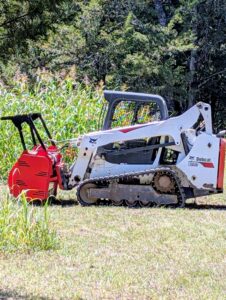
For landowners managing the state’s dense hardwood terrains, balancing development goals with environmental responsibility is essential. Selecting the right land clearing methods preserves topsoil, controls erosion, and enhances long-term property value.
Traditional Land Clearing vs. Forestry Mulching
Traditional land clearing relies on heavy machinery like bulldozers and excavators to push down trees, grind stumps, and dig up roots. While effective for total clearing, this method disturbs the soil profile, creates large burn piles, and requires costly hauling fees.
Forestry mulching uses a single machine equipped with a rotary drum to cut, shred, and blend vegetation into a organic layer of mulch. This method eliminates hauling costs and leaves the root systems intact to stabilize the soil.
The Mulching Advantage in Texas Hardwood Terrains
Texas properties are frequently dominated by dense stands of resilient hardwoods like Post Oak, Live Oak, Mesquite, and Cedar. Managing these species requires specialized approaches.
Erosion Control: Texas weather patterns alternate between severe droughts and heavy, sporadic downpours. The thick layer of mulch left behind acts as a protective blanket, reducing stormwater runoff and preventing critical topsoil erosion.
Moisture Retention: Hardwood mulch slows down soil evaporation. This retained moisture and supports the root health of your remaining desirable trees during hot Texas summers.
Oak Wilt Mitigation: Mechanical clearing can easily scrape and damage the bark of protected Live Oaks, leaving them highly vulnerable to devastating Oak Wilt fungal infections. Forestry mulching offers precise operational control, allowing operators to selectively clear invasive underbrush without harming precious canopy trees.
Key Steps for Responsible Land Management
Conduct a Property Assessment: Map out your property boundaries, identify the specific locations of desirable legacy hardwood trees, and flag areas with steep slopes that are highly prone to erosion.
Define Clear Development Zones: Decide exactly which sections require complete clearing for structural foundations or driveways, and which sections should be selectively thinned for optimal pasture health or wildlife habitats.
Select the Right Equipment: Heavy oak and mesquite require high-flow hydraulic compact track loaders or dedicated industrial forestry mulchers equipped with sharp carbide teeth to efficiently process the dense wood.
Plan Around the Seasons: Schedule your clearing projects during the late fall or winter months when trees are dormant to drastically minimize the risk of spreading tree diseases.
By utilizing forestry mulching, Texas developers can transform dense, unmanageable brush into clean, accessible, and ecologically stable acreage.
Learn the essentials of land clearing and forestry mulching for successful property development and responsible land management.